We are here to discuss U.S. presidential election issues through the lens of the youth vote. Five USC Annenberg journalism students have committed to this blog for one semester.
"This is a pull quote." -- Meriah Doty, USC Adjunct Professor
So check this out guys. Here is another blog written by Annenberg students about the elections. It's for a class, and I've heard they will be blogging all day next Tuesday. I just figured it might be interesting to see what some of our peers have to say about current political events.
Hi there, USC student. So really, what do you think about all of this? Last August I set out on watching the first Democratic YouTube debate with a group of Trojans. Enlightening? Embarassing? Either way, here's the transcript.
A group of five twenty-something college kids— Anam, Ashley, Josh, Nik, Sarah— gather around the television for an evening of debauchery, Disney Princess fruit snacks and Democrats.
Close up: Perfectly coiffed Anderson Cooper in full silver fox glory.
ANDERSON COOPER: Our first question tonight is from Zach Kempf in Provo, Utah.
ANAM: Oh my god, Anderson, you’re the heart of my ocean.
ASHLEY: Anderson you’re so dreamy.
SARAH: I’d vote for you Coop-y.
COOPER: Sen. Dodd, you’ve served in Congress for more than thirty years. Can you honestly say you’re any different than the rest of the Beltway crowd?
SEN. DODD: Well, I think so.
NIK: Really you think so? Why does his hair look like a croissant?
ANAM: (sighs) Oh man he’s so full of himself (reaches for fruit snacks). “Oh look at me, I’m old and white with fluffy hair like a dove.”
SARAH: (fixated on Cooper) Anderson you’re so dreamy. Come to my window.
COOPER: Mrs. Clinton, how would you define the word liberal?
SEN. HILLARY CLINTON: I prefer the word “progressive,” which has a real American meaning, going back to the progressive era at the beginning of the 20th century.
SARAH: Thanks for the history lesson Hil. Can you give me the low-down on muckraking and moonshine now?
ASHLEY: Yeah and maybe a brief synopsis on the causes of World War I?
SEN. MIKE GRAVEL: I want to take on Barack Obama for a minute, who said he doesn’t take money from lobbyists. Well, he has 134 bundlers. Now, what does he think that is? Besides that, he has received money from a Robert Wolf, the head of the USB…
COOPER: Sorry, your time is up, senator.
GRAVEL: …and it’s a foreign-owned bank!
JOSH: Doesn’t Gravel remind you of a grandpa who was haphazardly pulled from his rocking chair and just thrown onto the stage?
SARAH: C’mon Gramps! We got a debate to go to!
ANAM: But but but… I have to finish my Werther’s originals!
A five-minute conversation continues on possible Grampa Gravel scenarios just pre-debate, ie., taking a nap, drinking Metamucil, watering his plants. Everyone in the room comes to the consensus that since Gravel is 1) the former senator from Alaska 2) very old and 3) looks like he knows how to make good toffee, that he will now lovingly be referred to as Gramps.
YouTube Debate video submission of Sen. Dodd begins.
VIDEO QUESTION: Senator, how did you get the white hair?
DODD: Hard work, I suppose. For example, it took me seven years to pass the Family and Medical Leave Act, and I helped to end wars in Central America and bring peace to Northern Ireland. I’m ready to be president.
VIDEO QUESTION: Well, how many white hairs do you have?
DODD: Hundreds, thousands, I presume.
VIDEO QUESTION: Really?
DODD: I’m Chris Dodd, and we approved this message.
The group is silent for about 10 seconds.
SARAH: That was one of the worst videos I’ve ever seen.
ANAM: “I got white hairs from ending wars in Central America?” Whaa?!
ASHLEY: Fidel Castro still has black hair. He was involved in more wars than freakin’ Dodd.
JOSH: That’s cuz Castro dyes his hair…while smoking cigars.
NIK: So does Dodd.
SARAH: You can’t buy white hair color.
JOSH: You’re right… White hair doesn’t come out of a bottle. You can only get it by ending wars!
COOPER: Is anyone on the stage in favor of reparations for African-American descendants of slaves?
REP. DENNIS KUCINICH: I am.
Everyone in the room awws at Kucinich’s meager height and elfish smile.
ANAM: I LOVE YOU KUCINICH!
COOPER: Gov. Richardson, the Democrats talk a lot about the failure of the president to deal with Hurricane Katrina. The governor of Louisiana was a Democrat. The mayor of New Orleans was a Democrat as well.
GOV. BILL RICHARDSON: Well, there were politics… This is what I would do. The response of our government to Katrina, before, during and after, was inexcusable. We have got to eliminate in the future any red tape that helps families– er, that helps the devastation.
ANAM: Geez, what’s devastating is your face.
NIK: Yeah…So if you’re running for president, wouldn’t you at least try to lose some weight and attempt to look ruggedly handsome? Isn’t that in the playbook, a prerequisite, to be telegenic?
SARAH: He has no chance against dreamboat Edwards. I mean look at the guy— he’s a contemporary JFK, I tell you, a JFK!
Group starts throwing fruit snacks at Josh.
CLINTON: I couldn’t run as anything other than a woman.
ANAM: Um, because I thought you were going to run as a man?
SARAH: Or as Invader Zim?
COOPER: On sending troops to Darfur… You say U.N. troops. Does that mean American troops?
RICHARDSON: United Nations peacekeeping troops— and that would be primarily Muslim troops. Enough of our troops are in Iraq.
ANAM: Yeah, I guess he means troops from Arab countries, because there are no Muslim troops that are also American troops!
NIK: That’s a lovely coral pantsuit you’re wearing, Hil, I thought they didn’t wear color in New York?
KUCINICH: …now if people want to send that message to Congress, Anderson…
COOPER: Okay. Senator…
KUCINICH: …they can text “Peace,” 73223.
Everyone awws at Kucinich and then yells “Text peace! Text peace!”
GRAVEL: George Bush does not have the boots on the ground to invade Iran.
ANAM: You want some Werther’s Original, America? Edwards: While the Iraqi parliament is on vacation, is George Bush going to be on vacation in Crawford, Texas? What we need to do is turn up the heat on George Bush and hold him responsible and make this president change course.
NIK: Oh my god, if I was a housewife in Arkansas named Rose-Claire, I’d totally be in love with him… what a stallion!
SARAH: I think he’s performing the best. He’s so suave.
ASHLEY: And coiffed.
JOSH: Like Dodd’s hair.
COOPER: Gov. Richardson, you have had to implement No Child Left Behind in your state. Would you scrap it? Revise it?
In all the hours of presidental race coverage I've watched over the last several weeks, one canidate has completely been left off the radar. Republican canidate Ron Paul isn't even included in the reported cuacus counts. Some call him cooky, others call him radical, and then there are some that call him a genius. No matter what people call him or how many like him, I still think every canidate should get coverage.
Ron Paul is the only republican running that did not vote for the war. I think that is a pretty substantial difference between him, McCain, and Romney, yet the only attention I've seen him get is a handmade sign on the freeway that says "YouTube Ron Paul." Few people I've talked to know what he stands for (myself included), so I decided to follow the signs advice. Among videos claiming that Paul actualy won in the New Hampshire caucuses over McCain (click here to see one of those), there was another which I though communicated his ideas pretty well. If you're interested, check it out.
With this morning's news of John Edwards' withdrawl from the democratic presidential races, the question of the day becomes who will he endorse? He's worked alongside Obama and Clinton for over a year, heard their bickering and knows their policies. Where they stand on key issues will oviously be a big factor in who he choses to support. So do you know where they stand? Click on the following issues to compare Obama, Clinton, and Edward's stances on healthcare, Iraq, immigration, social security, taxes, same sex marriage, abortion, gun control and stem cell research. Make sure to compare them to the oppinions of republican front-runner John McCain too. Obama and Clinton't ideas on national security and Iraq will be a key topic of discussion with McCain who strongly supports military control in the Middle East.
Courtesy of cnn.com John McCain addressing Floridian voters after his win in the Sunshine State.
John McCain wins Florida.
That also means he obtained 57 delegates, and has been boosted past Mitt Romney into the Republican frontrunner seat with 95 total delegates.
Had the Democrats awarded their winner 57 delegates as well, Hillary Clinton would have hopped past Barack Obama to take the lead in the Democratic race.
But that's not the story of the day.
Instead, let's talk about McCain. He took Florida with 36 percent of the vote...the man who can be considered the furthest candidate from being connected with the youth vote. Now, is it possible that not only did McCain not get the youth vote from Florida, but that appealing to the elder community actually helped his campaign?
With all the attention paid to the youth voter, it is easy to forget about the other end of the spectrum. The Wall Street Journalreported that McCain's 71 years of age might have given him the edge in Florida, a state where the senior citizen population accounts for 16.8 percent of the total, compared with 12.4 percent nationwide.
And these voters bring something to the table the youth vote cannot...guaranteed support with a guaranteed vote.
The Wall Street Journal reported that the over-60 demographic played a large part in Mr. McCain’s win in South Carolina, where the U.S. senator from Arizona won 42 percent of the votes in that age group.
With all that said, there is a place for the youth vote, as it has played a huge part in this year's Democratic race. But when it comes to the conservative voters in this country, maybe America's past is just as important as America's future.
Click here to get video of McCain addressing his supporters after the big win today.
I’m young. Now wait, I’m not bragging. And don’t get scared, I’m no “To Catch a Predator” decoy, I swear. If I ever saw Chris Hansen, I’d give him a swift kick between the nuts; not because I think his show victimizes pedophiles or gives pedophilia an unfair rep. I just don’t like the guy. He’s a slick opportunist, constantly flossin’ and flaunting like he’s the NBC peacock. Do you know who I am, peder guy? I’m the NBC peacock! Get over yourself, Chris. But I digress. My point is that I can do all the things any healthy 21-year-old can do: drink heavily without worrying about a hangover, smoke like Kurt Vonnegut without worrying about cancer (because young people are invincible!), and have nightly Roman orgies that would make Caligula blush a bit. (I’m just being ironic; healthy people don’t do these things. And don’t you think it’s interesting that the word “romantic” has the word “roman” in it?) But I digress. My point is that as a 21-year-old I am in a very sought after age group. Because not only can I watch primetime television, I can also vote. With analysts predicting record voter turnout for the upcoming Super Tuesday primaries—especially among the 18-25-year olds—that kids my age wield an electoral power the likes of which haven’t been seen since the first “American Idol.” Hot damn, it’s a great time to be young and registered! The rest of this entry will be directed at you young voters because I’m sure the mature voters, Romans, and pedophiles have already gone to their MySpace pages by now. So that leaves you. This will also only address the democrats in the crowd. Let’s face it proud Elephants, your nominee is as good as chosen. Mitt Romney has been shredded during debates about the economy and is too wealthy to compete with John McCain’s war record; Rudy Giuliani’s pro-gay-marriage-and-stem-cell-research platform is too moderate for Republicans trying to forget about neo-conservatism; Mike Huckabee has been quick-witted during the debates but is completely broke; Ron Paul, bless him for trying, is too good to be true; and Fred Thompson? Well, you can’t be called an “Appalachian catfish wrestler” by Stephen Colbert and expect to become the most powerful man in the Western world. Republicans, McCain is your man. Back to the Donkey devotees. This is very important. In 51 weeks, if you want a Democrat to be living in the White House, do NOT vote for Hillary Rodham Clinton on Super Tuesday. My reasons have nothing to do with her qualifications as a politician, as a wife, as a mother, or as a human being. It stems from the fact that I don’t think she can beat John McCain head-to-head. He has absolutely bulldozed her up to this point. Look at it this way: the key to her campaign against Barack Obama has been her superior experience. She says she is ready to take office on day one unlike her rival the junior senator. But her experience is going to be mean absolutely nothing up against McCain’s “I was in the Hanoi Hilton while you were sipping Cosmos at Yale” routine. The scrutiny could suffocate the Clintons. According to Frank Rich’s latest New York Times column, the New York Post uncovered evidence that the Clinton Library was partly funded by Saudi Arabian contributors. I can see the commercials now: (Spoken in the voice of one of those gruff movie trailer announcers): What does a Clinton supporter look like? The Clintons won’t reveal who contributed to their library. It’s no wonder. (Pan into a picture of a grinning Saudi holding an AK-47 and a barrel of oil; show how much money the Saudis contributed along the bottom) What does a Clinton supporter look like? See for yourself. You don’t think the common voter will believe that? The same voters who thought a Purple Heart winner was less of a war hero than a man who railed lines of china all day on an air force base in the States? The same voters who twice elected a man who asked wondered aloud whether humans and fish could coexist peacefully? You get my point. And let’s not forget that the only thing Republicans hate more than the Clintons are Osama Bin Laden, Mahmoud Ahmadinejad, and Sean Penn. What better way to reunite the party than with Bill Clinton-is-a-cheerleader-for-his-wife jokes? I can see the flash animations already—Bill in a frilly tutu wearing a blue dress and a cigar hanging out of his mouth. The horror. But I digress. My point is that it is not a slam-dunk for Democrats this election, regardless of how poorly the previous president wielded his power. Now if you’ll excuse me, I have a romantic orgy to attend.
Los Angeles- Barack Obama doesn’t have a lot of experience; Hillary Clinton is an uptight control-freak; John Edwards has been called derogatory names by a number of political pundits painting him, at best, a soft-liberal; John McCain is too old, sick, and probably senile; Mitt Romney is devoutly Mormon and Mike Huckabee a religious nut; Rudy Giuliani is a one-hit wonder.
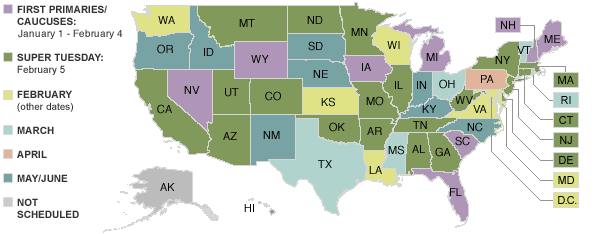
If they’ve watched or read any news at all in the past few months, residents of the 23 states hosting primaries and caucuses next Tuesday will undoubtedly bring these media-generated narratives with them to the polls.
As so many past presidential campaigns and elections have proven, we have a tendency to quickly link candidates to a certain character trait or policy stance that sticks with them throughout their race for office. Such defining narratives prove unforgiving historically, both in the media’s coverage and at the polls.
In the same way Al Gore was cast as a “liar” in his election cycle and President George W. Bush a “dope” in his, a number of presidential hopefuls have already fallen victims to such categorizations, many of them grossly exaggerated. History shows that as we near November, it’s only going to get worse.
Sometimes it seems as if our media outlets believe no one is fit to lead the country for the next four years.
Fueled by late night talk shows, comedy sketches and 24-hour televised political analysis, the stories that “sell,” according to many journalists, are the ones that fall within the context of whatever we already think to be true about a candidate, true or not. And stories that “sell” make up the majority of stories that “run.”
NYT, TXA and GCI are the ticker symbols of three of the most influential news-media outlets: the New York Times Company, Tribune Company and Gannett Company; They are companies with investors, and are accountable for how much revenue they generate, and in turn, how much they sell. This helps shape their coverage.
But all hope is not lost. The most recent political environment has given us a new hope for some legitimate social discourse and an informed voting demographic. There is a distinctly different aspect unique to this election and none other so far. In a word: access, and lots of it.
The average voter has more access than ever to engage in discussion and learn about the candidates. Every major news outlet has an election site and recent Google search yields 3,440,000 results to the query “2008 presidential election.” There is a new group of players in this game coming out in full force for this election cycle and they will either prove to compound and add to this damaging tradition or will, contrarily, weaken and break it.
Many of them have no quotas to fill, investors to please or agendas to set; a lot of them just want to have a say, and some have proven to be wildly talented and popular. They’ve taken to the Internet and made films, written articles, created pod-casts and taken pictures.
Wonder who it is? It’s you.
The American population is a “part” of the process more than it’s ever been before and with citizen journalism on the rise and thousand of blogs popping up every day, the average voter has the ability to revolutionize the process by utilizing their newly-found access.
What we do with the access will determine how this new reporting niche will act for years to come. Will the individual bloggers become obsessed with beating the news media conglomerates and report the same stories and chase the same broken narratives like the “real” media has done for years?
The power and affordability of blogging and the Internet takes away a lot of the constraints mainstream media companies have to pay attention to, and simultaneously sacrifice the integrity of their coverage for. Most blogs can be launched for free and are easy to set up and update.
Hopefully this election acts as a springboard for a new and different type of political reporting. While there is some truth to the characteristics first mentioned about the candidates as this article opened, that should only be one part of the story, not the filter through which the voting population must look if they want to learn about the candidates and election.
In 2006, Time Magazine said “You” were the person of the year. More than ever, you can make a difference and have a hand in shaping the future of the country in ways far more powerful that solely punching a card in a voting booth.
So the Florida primaries are underway...and should definitely not be overlooked. As we all know, Florida has long been key in the general election. According to cnn.com's election site, Republicans have not won the White House without Florida since 1924. And moving the Florida primaries up to January could potentially play a key role in the 2008 primaries.
As of this very second, according to yahoonews.com's election site approximations, John McCain is barely edging out Mitt Romney for the Republican party in Florida, while Hillary Clinton has a hefty lead over the rest of the Democratic pack.
The results in Florida could boost momentum for either McCain or Romney come Super Tuesday, just a week from today.
Obama made it extremely clear at the South Carolina debates that he doesn't appreciate the tactics Bill and Hillary Clinton have used to distort and falsely report his record. He fired back and emphasized what issues really need to be talked about - healthcare, the economy, and Iraq. He got the chance to set the record straight on his vote against the war, his comments about Regan Conservatism, and a bill he pushed to help protect victims of sexual crime that Hillary claimed he didn't support. The debate seemed to help. Obama won by a landslide with 55 percent of the votes. If you didn't watch the debate, watch this video to get a taste of what you missed.
While listening to the pre-class chatter of a crowded college lecture hall or the gossip of students gathered around a lunch table, one will hear a variety of topics… “Did you hear about Sandra and Mark hooking up last weekend?”; “Dude, that girl is flaming! Do you think her boobs are real?”; “I can’t believe Brittney Spear’s sister is pregnant.” We’ve all heard these types of shallow conversations. Even at an academically-driven school like USC, students are preoccupied with skimming Perez Hilton on their laptops during class, discussing who should have won MTV’s reality show Tila Tequila, or blabbing on about what a train-wreck Brittany Spears is. It is fairly rare to hear students in public discussing which presidential candidate has the best fiscal policy or what the best strategy is to get us out of Iraq.
Based on the infrequency of hearing these types of substantial conversations, adults are quick to judge youth as unaware of national problems, or, if not unaware, too preoccupied to do anything about them. Our parents, who grew up during the 60’s and 70’s when young people were vigorously protesting the war in Vietnam, seem to think that we aren’t interested or active enough to instigate change. “Where is your fight?” they ask.
They don’t understand that, while our battle is not being fought with picket signs on the White House lawn, it still exists, and in full force. For you see, our generation is uniting online. The web has become a forum for youth to learn about, discuss, and support presidential candidates.
If you don’t believe me, go look at the popular social site Facebook. Go to the political groups and you’ll find people sharing data, videos, photographs, polls and participating in in-depth debates. Don’t get me wrong - I’m not talking about a few people talking via chat rooms, I’m talking about thousands of young people actively talking politics. Take Barack Obama fans for an example: his fan group Barack Obama (one million strong for Barack) has 430,956 members, his group Barack Obama for President in 2008 has 65,536 members, the group Students for Barack Obama has 15,353 members, and another, America for Barack Obama, has 7,321 members . That is well over a half a million people from across the nation talking, sharing and interacting online.
But many ask, how will all this web-talk really affect the votes? Will it get youth off their butts, away from the computer screen and to the polls? I say yes. The web has ignited youth political awareness and activity. Their fight for change may not be as overtly obvious as that of our parent’s generation, but I believe we’ll see it in the presidential polls.
We already are at the caucuses. In New Hampshire the youth turnout rate rose to 43 percent (compared to 18 percent in 2004). In Iowa, it more than tripled since 2004 totaling 13 percent, and in Nevada, it rose to 13 percent. Of the youth voters who showed up to those caucuses, democrats made up 61 percent in New Hampshire, 80 percent in Iowa and a whopping 92 percent in Nevada (youngvoterpac.org).
What I’m really saying to adults is, don’t underestimate us. Just because we’re gossiping about Lindsay Lohan at lunch instead of politics and partying instead of protesting, we know what’s going on. We are fighting, just on our own cyber- turf. We DO want to see change, and I believe we will.
Wednesday, January 23, 2008
Conversations about the presidential election are popping up in all kinds of unconventional places, especially on college campuses.
For everyone who thinks America’s youth is relatively uninformed, think again.
In between stories from last night’s crazy party, what girls showed up and fuzzy accounts of only partially-remembered actions, a shirtless fraternity member looks up from his steaming breakfast burrito and says, “I wonder who will win South Carolina today.”
I looked up in surprise to hear the comment, but then one of his hung-over counterparts responded and a discussion ensued.
Perhaps this is different from the typical venue considered a likely spot for academic discourse surrounding the impending presidential election.
It’s probably more likely to imagine men and women in cocktail dresses and tuxedos buzzing around a penthouse apartment with soft piano music in the background and an impeccable view behind them.
Not so here, no venue is safe, not even for young adults.
The 2009 election marks the first opportunity for involvement in the democratic process for more than half of America’s undergraduate population. More than half of USC’s population was under 18 at the time of the last election.
But whether it’s in a fraternity dining room or at the local hot spot bar, America’s youth is talking about the election in their spare time, not just when asked to do so by professors.
At each of the four social events I attended over the weekend, serious conversations broke out about the election, by people who actually had a reasonable knowledge base to bring to the table.
I overheard two third year college students arguing at the local watering hole amid hundreds of other stumbling young adults sipping their drinks and commiserating.
“I’m just so sick of all the people who talk about this election like they know what’s up,” said the guy to the girl. “That’s why I made a huge chart for everyone to hang up and actually learn about.”
I expected to turn around and see a weasely, skinny kid with a comb-over and pocket protector. Instead, I found myself staring at a tall, average fraternity member from a reputable house.
I asked him to send me his graph. It’s rather impressive, given the amount of time it must have taken, not that I agree with it all. The column that says, “my views” are his, not mine. I will include it below.
The social discourse occurring is an essential part of the democratic process and our responsibility, given our duty to gain knowledge of the leader’s we’ll elect in less than a year. It’s comforting to see that even the newest members of the voting population are participating.
Today is the last day to register to vote in California for its primary next month. Have you registered yet? Because in front of Tommy Trojan here on the campus of USC there are people from CALPIRG who are willing to help you submit your registration form by hand before midnight tonight. There’s almost no excuse not to register to vote anymore; it’s one of the basic rights we as Americans are fortunate enough to have—in Hong Kong they’re still pushing for a democratic election for its chief executive by 2017.
So you’ve registered to vote, now what? Call me ignorant but as an average American, I’m still a little hazy on the whole concept of primaries and caucuses. Who decides the order of the primaries? Why are caucuses so important? Who are the delegates? Do our votes matter in the primaries? Why do some states have an open primary and some states have a closed primary? Sure, most Americans studied American history or government in high school, but if I were to ask a random person on the streets to explain the whole idea of how primaries or caucuses work, they probably wouldn’t know why their vote is important in the primary next month.
So this is how it works. Before the general election, each party must elect a representative for the presidential election. Ten states hold caucuses; seven others host a combination of primaries and caucuses, while the remaining thirty-three states hold primaries. Each party must request state legislatures to pass laws whether the hold primaries and caucuses.
Caucuses are when registered voters attend a meeting to select delegates who demonstrate support for their presidential candidate. There are different types of delegates for each party. The Democratic Party has pledged delegates and superdelegates. The former are elected to the position and he or she will show support for a particular presidential candidate, but are not bound to vote for the candidate. The latter are Democratic National Committee members and Democratic members of Congress, former presidents, vice presidents, governors, congressional leaders etc. who are not required to indicate a preference for a candidate and do not compete for privilege like pledged delegates. The Republicans have pledged and unpledged delegates. The latter are not required to show a preference for a candidate and are elected just like pledged delegates on a state and local level.
Primaries are elections when registered voters directly vote for their candidates through a secret ballot. For the Democratic Party, the popular vote percentage is directly proportional to the number of pledged delegates given to each candidate. But a candidate has to have at least 15% of a popular vote to get any pledged delegates. The Republicans do not require a 15% threshold like the Democrats do, but individual states have their own rules. Some states use a “winner takes all” system where the candidate with the most popular vote gets all the delegates, and some states use the same proportional system as the Democrats do.
The Iowa caucuses and the New Hampshire primary were the most important because they were the earliest contests—the votes there would determine the race for the rest of the presidential elections.
Confusing? I thought so. Don’t get me started on the Electoral College. But this means that our vote as the general population does matter. Every vote counts.
As Barack Obama and Hillary Clinton, the two leading democratic candidates, fight for South Carolina’s votes in advance of Saturday’s primary, one issue has taken center stage—even as many voters try to distance themselves from it. Questions about whether the state’s black women—whom analysts estimate will make up more than one-third of democratic voters—will vote for their race or their gender have been increasing steadily over the past few weeks. The intrigue surrounding the possibility of the first black or female president in history has been discussed in online forums, “talking head” cable shows and late-night show monologues for months. But now that the donkey party’s three-ring nomination circus has set up in this typically conservative (and historically racist) state, the race vs. gender “debate” has reached a fever pitch. But should this really be an issue? A Jan. 21 article on CNN.com titled “Gender or Race: Black women voters face tough choices in S.C.” was one of the most popular articles written that day. In it, the author visits a popular hair salon (many of which are being targeted by candidates because they are popular places for women to gather and talk) to listen in on the day’s political debates; namely, what dem candidate will get the vote? While most of the conversation—both in the salon and the body of the article—centered on issues like the economy, healthcare, and whether experience will play a role for voters, the title of the piece would lead readers to believe the theme was more sociological than political. Readers took serious offense to the website’s suggestion. CNN.com received dozens of angry and sarcastic emails from readers angered by the notion that they would think only about their race or gender when determining a candidate best suited to win the White House. One said: “Duh, since I'm illiterate I'll pull down the lever for someone. Hm... Well, he black so I may vote for him... oh wait she a woman I may vote for her... What Ise gon' do? Oh lordy!" To the website’s credit, an editorial was published within hours featuring many of the email’s responses. There was no apology or explanation given beyond what the emails brought up. Not that there should have been. The original piece—and the subsequent editorial—broached an interesting concept. Naturally, a candidate’s policy and their ability to stick to it are of more concern to a voter than their skin color or sex. But the distinction is historical and deserves to be discussed. Black women, especially those in the south, are faced with a unique pressure to vote their race. For the first time in our political history, the voting process has been affected by the perception that race trumps gender. Sensationalist media outlets deserve to be checked by its readers. Otherwise, we’ll be getting our election coverage from The Globe and TMZ.com (Duff? Nah. We got pics of the other Hillary taking body shots in Acapulco!) But while the article could have gotten a less leading headline, the story never actually deemed race and gender a voting prerequisite. Sarcasm may be hard to resist, but we should only check that which deserves to be checked. Hopefully, cooler heads will prevail, and we can all discuss this with scrutiny and humor like adults. At least, the candidates are. At Monday’s debate, Obama was asked about Toni Morrison’s comment that Bill Clinton was America’s first black president. “I would have to investigate more of Bill's dancing ability…before I accurately judged whether he was, in fact, a brother,” said Obama. To which Clinton responded, “I’m sure that can be arranged.”
http://www.cnn.com/2008/POLITICS/01/21/blackwomen.voters/index.html?imw=Y&iref=mpstoryemail --gender or race article http://www.cnn.com/2008/POLITICS/01/21/emails.race.gender/index.html?iref=mpstoryview – editorial
In past election years, the youth vote has been deemed difficult, if not impossible to receive, for the majority of young voters have not shown up at the polls. Much of America's youth had little if no interest in politics, and the indifference was felt in the numbers. But this election year is different. There is a revival of American youth's interest in politics, and candidates are trying to tap into the demographic for voting support.
With Super Tuesday fast approaching, it remains to be seen how influential the youth vote will be for many states' outcomes. However, there has already been a significant rise in the youth vote in this month's primaries in New Hampshire and caucuses in Iowa compared to four years ago. The youth vote was even credited for helping Barak Obama with for the Democrats in Iowa.
According to AFP, a global news agency, 13 percent of voters under 30 turned out for the caucus in Iowa, against four percent in 2004, while youth turnout in New Hampshire surged ahead from 18 percent four years ago to 43 percent.
As I am also from New Hampshire, I was able to survey a few members of the youth demographic from there to get an idea about their views on voting and politics. Their answers follow. Each person's answers will be in a different color to tell them apart.
How old are you? 21 20 22 Did you vote in the 2008 New Hampshire primaries? Yes Yes No If you answered “yes,” please answer the following questions: Who did you vote for? Rudy Giuliani Rudy Giuliani Why did you vote for him/her? The things he did in NYC Sept. 11. Because im a registered republican and it was a tough call on who to vote for. Do you feel he/she appeals to the youth vote (18-24)? No Not really, no If yes, why? If not, why not? I feel he is not a publicized as the others. I think the younger generation today is looking for a change aka a woman or an african american president, the younger generation today wants to make history and a difference. Do you think it is important to exercise your right to vote? Yes Yes, it is such a privilidge as an American to be able to vote for a president, we are very lucky to have a say as to who runs our country. Were you old enough to vote in 2004? Yes No If yes, did you vote then? Yes - George W. Bush Do you feel like your vote counts? Yes Absolutly...if people didn't vote, we wouldn't be anywhere as a country. If you answered “no” to the second question, please answer the following questions: Why didn’t you vote? I just never made it to register. I wanted to though. Do you think it is important to exercise your right to vote? Yes, if you don’t vote then I think you shouldn’t get to voice your displeasure about the government. Were you old enough to vote in 2004? Yes If yes, did you vote then? Yes Do you feel like your vote counts? Yes
Whether or not you voted, please answer the following questions: What do you feel are the most important issues surrounding the 2008 election? Health Care and Foreign Relations The war in Iraq is number one I believe The war in Iraq and the looming recession are pretty big issues. What are you looking for in a presidential candidate? Someone to figure a way to boost the economy and do positive things for people in all different social classes. Positive change for America to make our country a better place where everyone is treated equally and given a fair chance. I look for strength in hard times, good moral fiber and preferably a military background in a presidential candidate. Is it important to you that whomever you support appeals to the youth voter? No No, although I believe our youth is most important considering they will be the next in line to make big decisions having to do with running this country. No, not really. He/she should appeal to as many people as possible, not just the youth. Do you feel like you are well informed about the issues surrounding the 2008 election? Yes I feel like I definitely could be, although its not a huge interest to me at this point and time. Yes, I don’t think anyone could say that the media isn’t doing its job. Do you feel like you are well informed about each candidate’s platform? Yes Yes For the most part, with all the commercials and talk shows each candidate does. But it has really become a popularity contest and not so much about the real issues. Do you believe most of your peers are engaged in the 2008 elections? No No Most of my peers don't even know who is running. But my age group does I believe.
To get some data on past numbers from youth voters, click here and scroll over the states on the map.
RomneyHuckabeeObamaClinton! Oh no, oh my! News coverage of elections become literal sports commentary: big, bold flashing graphics, easy numbers, little interpretation. Who’s ahead? What do the polls say? We want facts, not discussion. With everyone fluttering around numbers, it’s easy to get lost in the plot. But what about the electoral college system itself?
With over 2,000 political parties in the world, it's a shame the United States champions only two of them. Travel to Germany and you'll see five major parties listed on the ballot with more than 20 smaller ones. Travel to India and you'll find people voting for the Bahujan Samaj Party, the Nationalist Congress, the Bharatiya Janata.
A glaring difference between how the government works in the United States in comparison to nearly all those democracies abroad is its heavy reliance on an uncomplicated two-party political system. With one side naturally pitted against another like a team sport, much of American philosophy and thought has become polarized into diametric frames of thinking as a result.
This divided system has inadvertently perpetuated a left vs. right, Democrat vs. Republican, liberal vs. conservative, "us vs. them" political mentality. Think about it - are you a proponent of national health care? You're labeled a liberal, a Democrat, a blue-stater. Against abortion? You're automatically considered a conservative, a Republican, red as a stop sign. The labels are easy, they're quick, they're convenient.
They're also incorrect.
It is not human nature to think in pure terms of black and white and it's not natural to polarize people's belief systems in completely opposing blocs that are so large its members cannot agree on the same issue.
Without a proportional voting method, however, minority parties will never be counted as whole votes unless they win an entire constituency. The system must be reformed if we ever want a country that is more than two simple, stale and staid political parties whose standpoints often bleed into one another, and more often than not, cannot be distinguished from one another.
Perhaps it has to do with the fact that it's much simpler to throw people into two opposing sides. It takes less thought and less brainpower. But the truth is humans are meant to think without concrete party labels obstructing their view. They shouldn't have to deal with flashing words and absolute ideas. At least they should have more options. They cannot think, "I really don't believe in this, but I think I'm supposed to since apparently I'm liberal/conservative/red/blue/bleeding heart."
Indeed, most people, myself included, find themselves frequently thinking outside party lines on certain issues, stuck in the gray area between the two extremes. This is why the centrist members of a particular party can so easily gain control. Because in a form of government that is neatly divided along the middle, the moderates always win since parties' leaders are too afraid of delving into either extreme. Yet, as a result, the raw political flame of change has blown out and the end product is compromise, concession, moderation, flip-flops, apathy and disregard.
An old senator once said, "Saying we should keep the two-party system simply because it is working is like saying the Titanic voyage was a success because a few people survived on life rafts."
I like that. And perhaps poor Dennis Kucinich does too. Read about his exclusion from the Las Vegas debates here.